

Growing up is an initiation
Be the parent who guides them through it
Virtual parent coaching for families of neurodivergent and struggling kids, teens, and young adults, wherever you live.
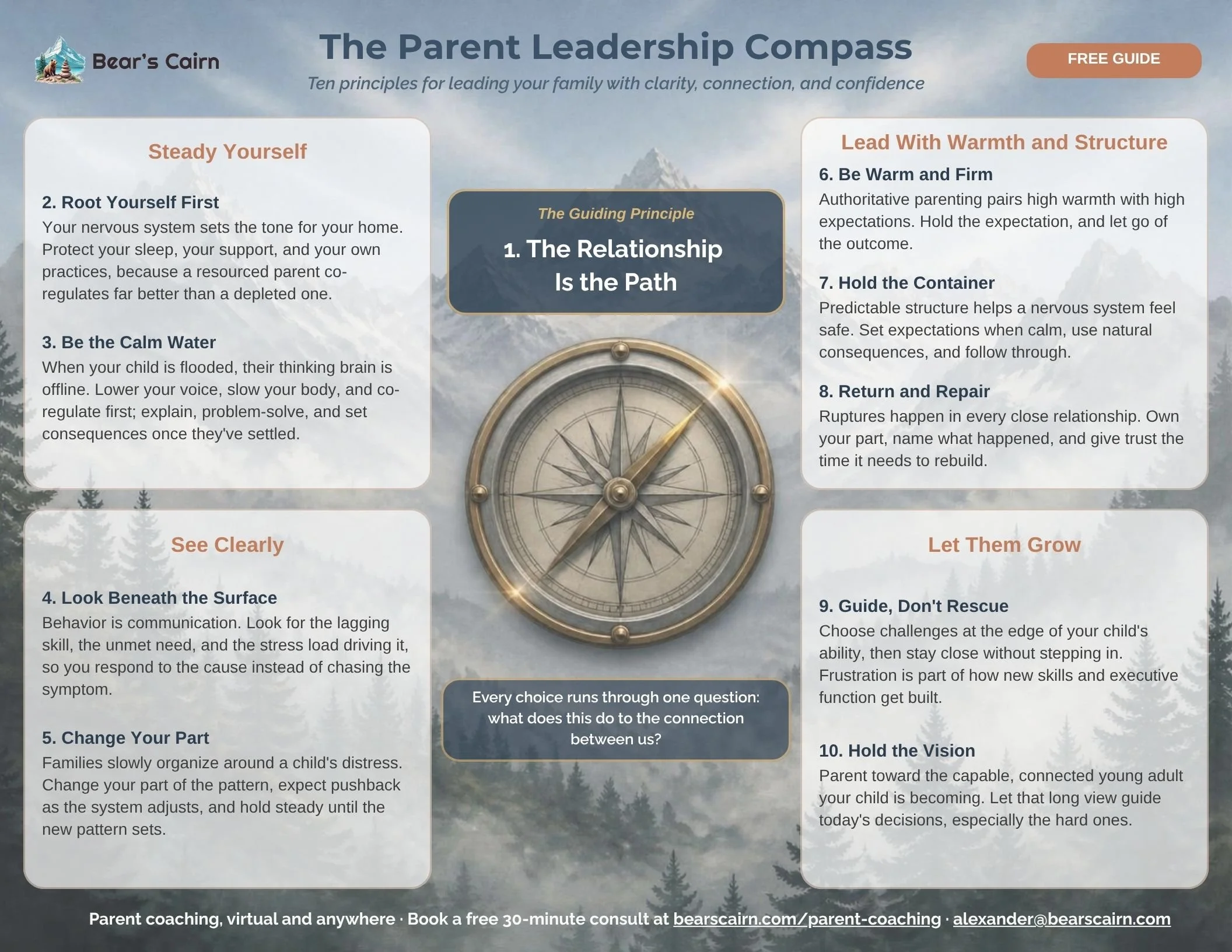
Free: The Parent Leadership Compass.
These are the ten principles behind all of my work, arranged around the relationship at the center.
Does this sound like you?
Every "no" becomes a negotiation, and the screens keep winning.
You're working harder on your kid's life than they are.
You know what to do, but in the heat of the moment it falls apart.
Your kid has plenty of helpers, but nobody is holding the whole picture.
You've decided your own needs can wait until your kid is okay.
You and your co-parent share the vision but can't agree on the path.
If any of these landed, you're not failing. You're carrying something parents were never meant to carry alone.
How families get stuck
Most families don't choose these patterns. They drift into them one loving, reasonable step at a time. A child melts down, so the household adjusts. Mornings become a battle, so a parent starts doing it for them. Each accommodation makes sense on its own, and together they slowly reorganize the family around a child's distress, until that distress is quietly running the household. Researchers call this family accommodation, and it's the most common pattern I see.
The house bends around the hard moments.
Daily life starts orbiting the next meltdown. Negotiation and power struggles become the rhythm, and the child's stress, rather than the parents' leadership, quietly sets the agenda.
Support gets scattered.
Tutors, therapists, coaches, and activities each hold a slice. Nobody holds the whole picture, and the calendar leaves little room for the relationship that holds it all together.
Parents manage instead of lead.
Doing for a child, rather than with them, removes the productive struggle that builds executive function, frustration tolerance, and real confidence.
Exhaustion lowers the bar.
When holding expectations costs this much, depleted parents gradually stop holding them, and the child loses the structure their nervous system needs to feel safe.
The cost shows up later. Young people who have had little practice doing hard things, failing, and recovering often stall at college or a first job, right when the scaffolding falls away. Avoidance that once protected them hardens into a belief about who they are: "I can't." This is where initiation matters most, and it's why the work starts with you.

Raising young people into adults
Cultures once had ways of guiding young people across the threshold into adulthood: mentors, real responsibility, and rites of passage that asked something of them. Today kids grow up in a world flooded with options, activities, identities, and partial truths, and many have lost the deeper paths that once made young people strong, resilient, and capable. Struggling kids often feel that loss first, and their parents end up carrying it alone.
My work helps parents become the mentors and guides our culture has lost, starting at home. In practice, that means reading the need beneath hard behavior, co-regulating instead of escalating, and building structure that expects more of your child because you believe they can meet it.
None of this is a verdict on you. Your leadership is the most available lever for changing course, and the goal isn't a compliant kid; it's a capable, connected adult, and a parent who grew alongside them.

Alexander Traugott, M.A., Holistic Counseling Psychology
Trauma-informed training
AMGA Single Pitch and Climbing Wall Instructor
A coach, not a licensed clinician
My path here
I came to this work through mental health. I earned an M.A. in Holistic Counseling Psychology and spent more than four years as a milieu counselor and adventure programming coordinator in a Denver intensive outpatient program that worked only with whole families. Family clinicians and parent coaches mentored me there, and I learned that young people rarely change alone; their families change with them.
Since then I've mentored young people from age 9 to 28 in their homes, in climbing gyms, in peer groups, and in the backcountry, and I've coached their parents alongside them. Across seven years in mental health settings, I've worked with more than 50 families.
Parent calls began as case management and shared language, and parents kept asking for more: examples, scripts, and how to carry it out at home. Those requests became the Parent Leadership Compass, and today they also shape the workbook-style reflections and practice tools I build with each family. They also taught me that parents are usually the most available lever in a family, so today I often begin with parent coaching before working directly with a kid.
Adventure is part of how I work, not the whole of it. A climbing wall or a backcountry trip puts real challenge in front of a young person, and challenge reveals what conversation often can't. What I bring home to parents is what those moments teach: how to lead with the relationship, hold structure without losing warmth, and let a child struggle productively.
I'm also raising a young son, and the same principles guide me at home.
A Different Kind of Parent Coach
I know your kid's world.
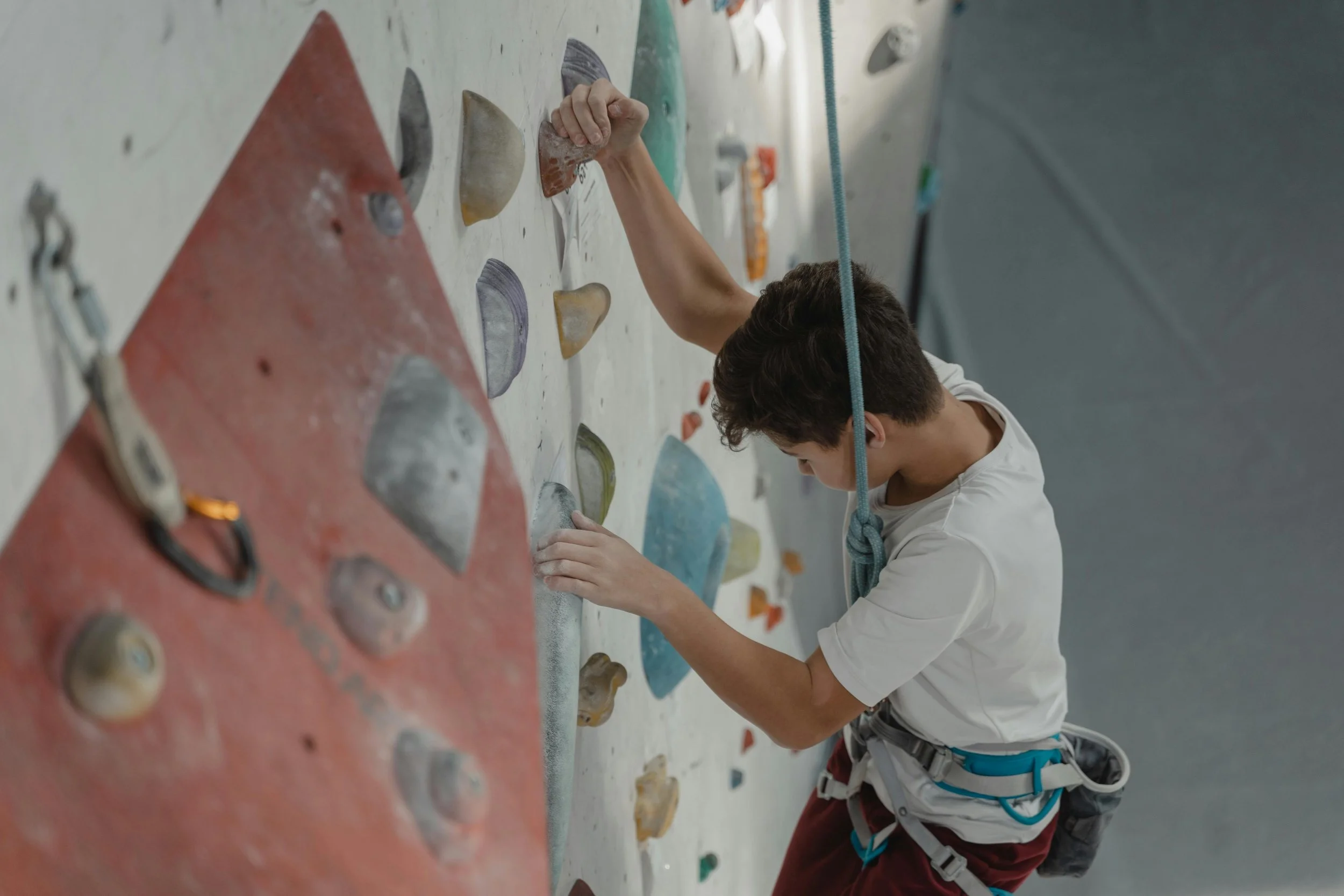
I've mentored kids like yours at home, on the climbing wall, and in the backcountry, in the moments that test everyone. You get the same tools and language I use with them.

I coach the whole adult
Your sleep, stress, relationships, and sense of purpose are part of the work. A resourced, grounded parent leads from a different place, and your steadiness is where your child's growth begins.

I bring clinical depth
An M.A. in Holistic Counseling Psychology and years in a family-based intensive outpatient program inform every session: nervous system regulation, family systems, and how skills actually develop. This is coaching, grounded in clinical training.

I'll push you
This work is warm, and it is demanding. I'll name your blind spots, hold you to your commitments, and stay in your corner while you practice the hard parts.
The Parent Leadership Compass
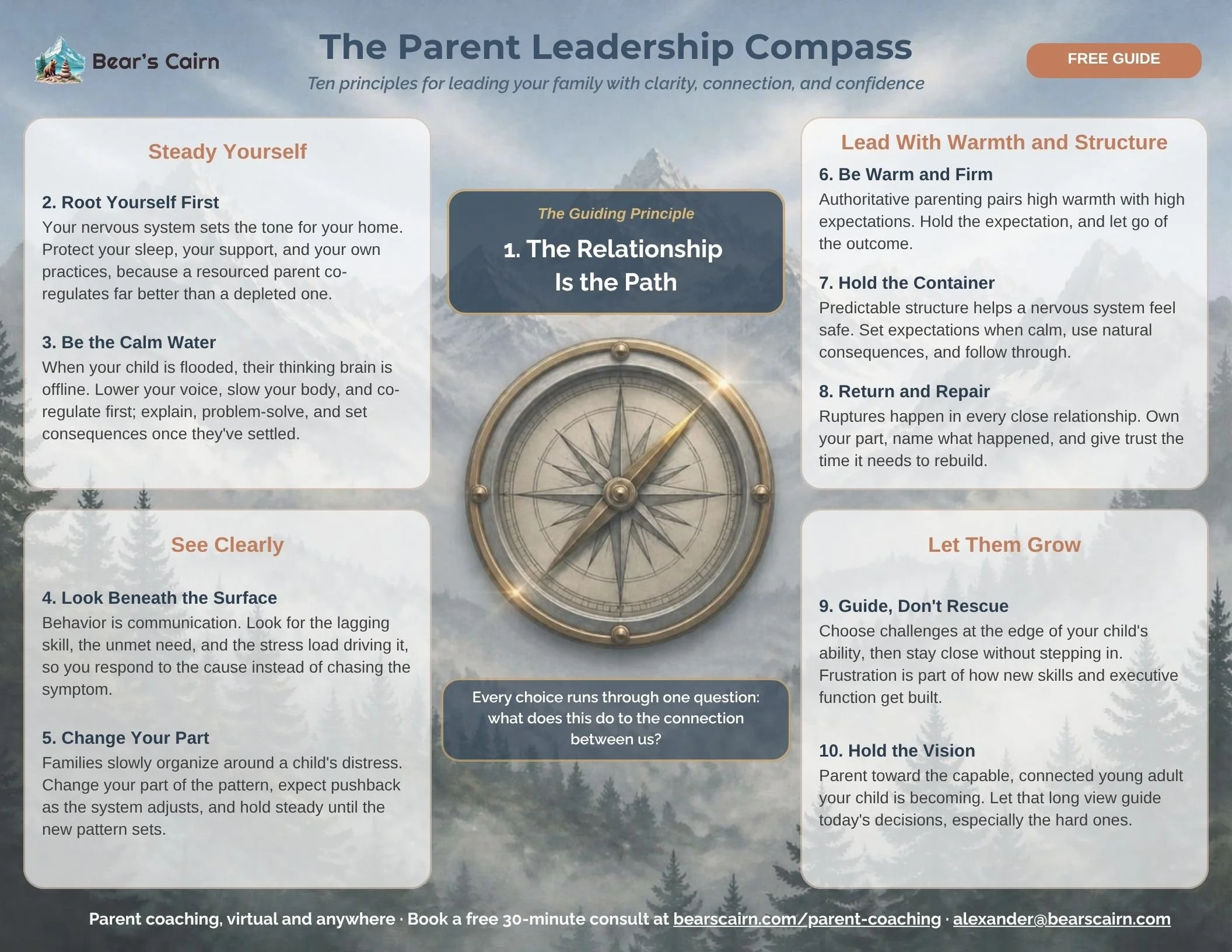
My coaching follows the Parent Leadership Compass, ten principles taught in sequence and applied to your family's real situations. We usually begin with your own steadiness, then build a deeper understanding of your child, then put warm and clear structure in place, and finally make room for real-world practice, where your kid struggles productively with you beside them. The relationship stays at the center of every step. Which principles come first, and how we apply them, depends on your family.
At the center: The relationship is the path.
Steady Yourself: Root yourself first. Be the calm water.
See Clearly: Look beneath the surface. Change your part.
Lead With Warmth and Structure: Be warm and firm. Hold the container. Return and repair.
Let Them Grow: Guide, don't rescue. Hold the vision.
The Compass draws on the work of Ross Greene, Dan Siegel, Gordon Neufeld, Gabor Maté, David Yeager, and Eli Lebowitz, and on years of practice with kids and families in the field.
How it works
Onboarding. A written intake, a 90-minute on-boarding session, use to create a written roadmap built around your family's patterns, priorities, and your child's profile.
Coaching sessions. Virtual sessions that pair the Compass framework with whatever is actually happening in your home that week.
Workbook-style recaps. After each session you receive key insights, scripts for the hard moments, commitments, and reflection questions in addition to small, concrete practice tools that connect the science behind each principle to your child and your family system, plus structures like a technology plan or an order of priorities as you're ready.
Between sessions. Support for the moments that can't wait, so you aren't left guessing alone.
Coordination, when needed. More involved coaching can include coordination with your child's school and providers, so one person holds the whole picture.
Most of the change happens in the practice between our calls. Skills, especially under stress, are built through repetition, which is why the pace is steady rather than fast. In the climbing world, the saying goes: slow is smooth and smooth is fast, and the same holds true here.
What Families and Colleagues Say





Want the Whole Family Involved?
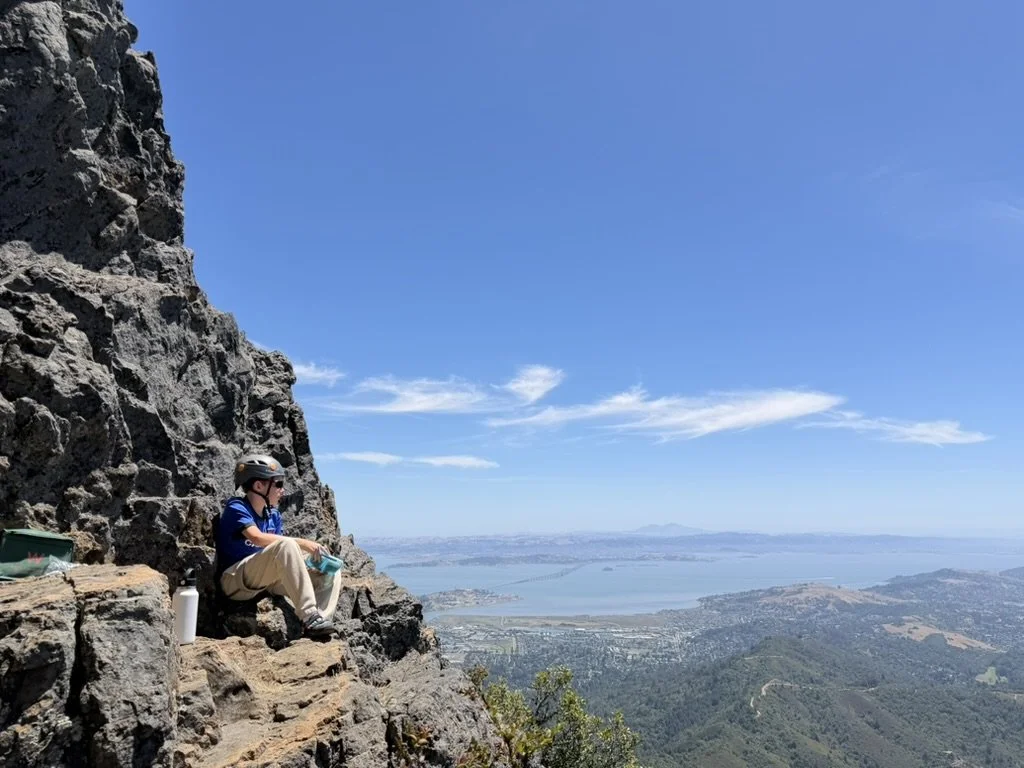
In Marin and the Bay Area, parent coaching pairs with my in-person youth mentorship, which combines climbing, wilderness experiences, and real-world coaching, so your whole family learns one shared language. For many families, parent coaching is the right first step.
Investment
Onboarding is $550. Ongoing coaching is a monthly investment tailored to your family. Coaching is private pay and is not billed to insurance.
Questions Parents Ask
-
Yes. Parent coaching is fully virtual, so you can work with me from anywhere.
-
You can still start. Your leadership is the most available lever in your family, and the work begins with you either way.
-
No. I'm a coach, not a licensed clinician. My training is clinical, but our work is practical coaching focused on what you do next.
-
Real change takes months rather than weeks. We set a pace your family can sustain, and the practice between sessions matters more than the number of calls.
-
They often do. When you change your part, the family usually pushes back before it settles, and that pushback tends to mean the old pattern is being tested rather than that you're doing it wrong. Knowing it's coming is what keeps parents from quitting right before things begin to shift.
-
No. Coaching is private pay.

Your kid doesn't need a perfect parent; they need a steady one.
Let's start there.
Book your Free 30-minute consultation
This is a conversation about your family, and you don't need to decide anything on the call. Your child doesn't need to be involved or ready. We'll talk about:
What's happening at home and what you've already tried.
Whether parent coaching fits your family, and what working together would look like.
What the first steps would be if it does.
If it isn't the right fit, I'll tell you.